Allied Invasion of Normandy
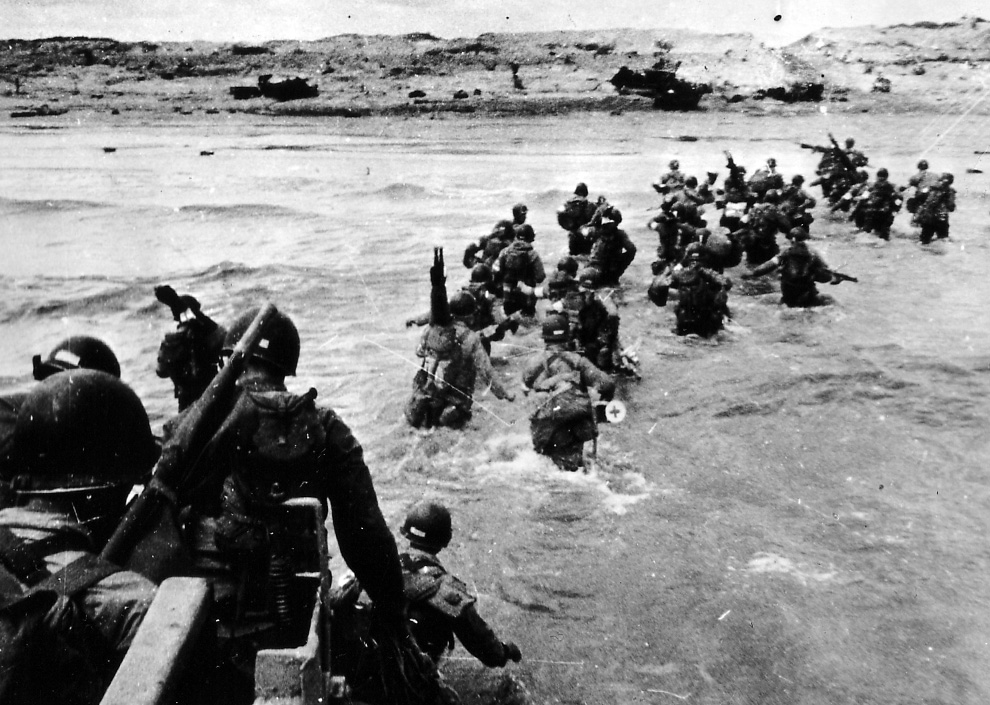
The Allied invasion of Normandy, France, otherwise known as "D-Day," was a major turning point in World War II. I even point to D-Day as the beginning of the end for Hitler and the Nazis. Let's look a bit closer at the brave, daring invasion of Normandy.

D-Day, codenamed "Operation Overlord," occurred on July 6, 1944. Both the Germans and the Allies knew that there were two logical, feasible places to invade France, which were Calais and Normandy. The Allies, trying to trick the Germans, placed General George Patton with a decoy army at Calais. To counter-act the Allies, the Germans placed their strongest troops at Calais, but also placed another army under the command of Rommel at Normandy. The Allies also made other preparations for the attack, such as building an underwater pipeline from England to France, clearing a path in the English Channel, and sending engine planes across with men and equipment. Then, the next day, D-Day began.

In the early morning of July 6, General Dwight Eisenhower sent the first wave of paratroopers into France. Unfortunately, only about one third of the paratroopers hit their targets. Operation Overlord wasn't off to an great start. Then, at 5:00 AM, the mini-submarines successfully marked the crossing zone for ships. Then, Eisenhower sent four to five thousand sea vessels across the English Channel.
There were five, planned landing spots at Normandy. Their code names were: Gold, Juno, Omaha, Sword, and Utah. Artillery was showering over all, mines were exploding left and right, barb wire fencing was trapping all. The Germans tried to fight off the Allies, but in the end, 80 miles of France was captured in a day, but at a cost of 5,000 lives.
Sources:
First picture courtesy of: http://www.29th.co.uk/photos/dday/dday4.jpg
Second picure courtesy of: http://inapcache.boston.com/universal/site_graphics/blogs/bigpicture/dday_06_07/d01_0p011976.jpg
Mystery of History Volume 4


No comments:
Post a Comment
Thank you for commenting!